Mera Peak Climbing 17 Days

Tour Info

trip code

EN-017

Starting Point/ End Point

Kathmandu

Accommodations

Lodge/ Tea House

Max Altitude

6476 m (Mera Peak)

Duration

17 days

country

Nepal

Trip grade

Challenging

Activities

Trekking , Climbing

Best Season

February, March, April, May, June, September, October, November and December

Overview

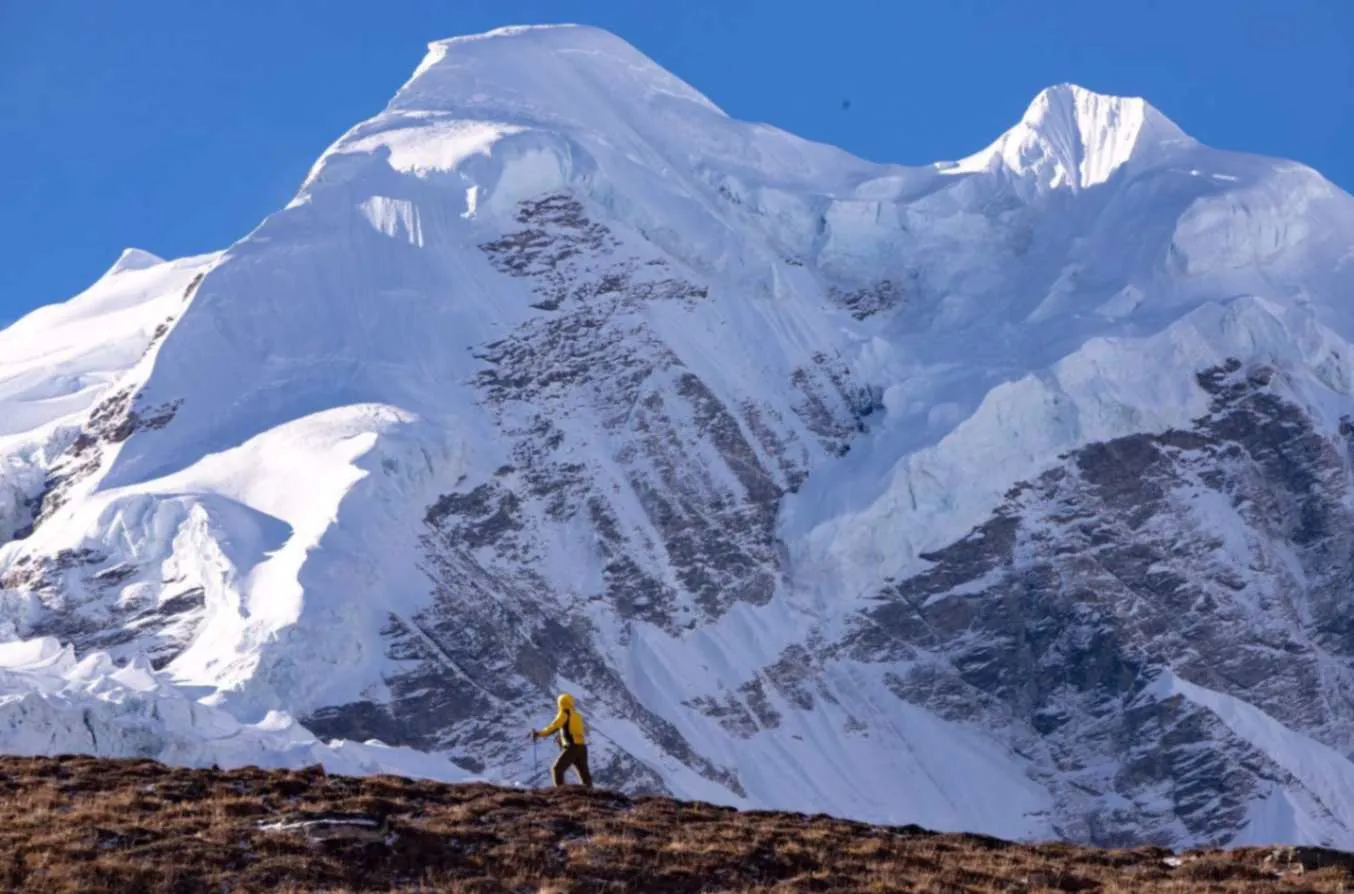
Mera Peak Climbing is one of the most popular and rewarding climbing adventures in the Himalayas. It takes you to the top of Mera Peak (6,476m), the highest trekking peak in Nepal. Hidden away in the remote Hinku Valley, this beautiful peak has become more popular in recent years because of its peaceful trails and wide mountain views. Mera Peak has three summits, Mera South (6,065m), Mera Central (6,461m), and Mera North (6,476m), with Mera North being the highest and most commonly climbed. The journey passes through quiet villages, forests, and high alpine landscapes before reaching the snowy glacier zone.

Often called a “practice peak” of the Himalayas, Mera Peak is ideal for both beginners and experienced climbers. The climbing route is straightforward, and with proper training alongside acclimatization, it is a great introduction to high-altitude mountaineering. The real reward comes at the summit, where you are surrounded by five of the world’s highest mountains, Everest, Lhotse, Makalu, Cho Oyu, and Kangchenjunga. At Ever Nepal, the climb is fully guided by experienced professionals who focus on safety, proper training, and support, helping you enjoy a confident and unforgettable Himalayan climbing experience.

Details

Mera Peak Climbing is a great choice if you want to experience a real Himalayan summit without the complexity of extreme mountaineering. At 6,476 meters, it is Nepal’s highest trekking peak and can be climbed without the hassle of special expedition permits. From the summit, you are rewarded with incredible views of Everest, Lhotse, Makalu, Cho Oyu, and Kanchenjunga, all rising above the clouds. Along the way, you also get a close look at Sherpa village life, their monasteries, prayer flags, and stone carvings. The journey blends trekking and climbing perfectly, with comfortable teahouse stays, a few nights of camping, and the excitement of a true high-altitude adventure inside Sagarmatha (Everest) National Park.

The trip starts with a scenic flight to Lukla, followed by a trek through peaceful and less-crowded trails of the Hinku and Hunku valleys. This route is quieter than Everest Base Camp, making the experience more personal and calm. And, the climb itself is non-technical, with gentle slopes and fixed ropes to guide you safely to the top. Proper acclimatization days and basic climbing training help you feel confident on summit day. After reaching the top and soaking in the views, the journey ends with a scenic return flight to Kathmandu. Mera Peak climbing is ideal for trekkers with good fitness who want their first big Himalayan climbing experience.
Highlights

  • Walk from Khare through beautiful high-altitude landscapes.

  • Reach the summit of Mera Peak (6,476m), the highest trekking peak in Nepal.

  • Enjoy amazing mountain views from the summit, including Mount Everest, Lhotse, and Makalu.

  • Experience real Sherpa culture while passing through local villages and small monasteries.

  • Test your strength and mindset as you step out of your comfort zone.

  • Watch beautiful sunrises and sunsets over snow-covered peaks during the trek.

  • Cross Mera La Pass, known for its wide panoramic views of mountains and valleys.

  • Feel the excitement of walking across glaciers, moraines, and icy sections.

  • Explore the cultural and historical highlights of Kathmandu before and after the climb.

Itinerary

Day 01: Arrival in Kathmandu and Pre-trekking Preparation

After arriving in Kathmandu, you are welcomed at the airport and transferred to a comfortable 3 or 4-star hotel. Once checked in, you have time to rest after your journey. Later in the day, you go through trek preparations, including checking your gear, reviewing the itinerary, and giving a short briefing on safety and the overall plan for the trek. The rest of the day is free for you to explore at your own pace. You can take a short walk around the city, visit nearby streets and markets, or simply relax at the hotel. In the evening, dinner is provided and you can enjoy a calm first night in Nepal before heading to the mountains.

  • Accommodation: 3 or 4 star hotel
  • Travel Distance: 6 to 8 kilometers
  • Travel Hours: 20 to 30 minutes (depending on hotel location)
  • Maximum Altitude: 1,400 meters (Kathmandu)
  • Meal: Dinner

Day 02: A Full Day Guided Tour and Sightseeing in Kathmandu Valley

This day is fully reserved for exploring Kathmandu city. After breakfast, your sightseeing tour begins with our guide. You visit several UNESCO World Heritage sites in a private vehicle for about 4 to 5 hours. The places you will see include:

  • Swayambhunath Stupa (Monkey Temple): Located on a hill on the western side of the city, this stupa is home to many monkeys. From here, you can enjoy a panoramic view of the Kathmandu Valley.
  • Pashupatinath Temple: A sacred Hindu temple on the banks of the Bagmati River, dedicated to Lord Shiva. The temple is made of pagoda-style architecture, ancient statues, and scriptures, with four main doors and a golden spire on top.
  • Boudhanath Stupa: An ancient Buddhist stupa built around the 5th century. It has eyes on all four sides that watch over people’s karma. Pilgrims walk around the stupa, spinning prayer wheels for blessings.
  • Bhaktapur Durbar Square: The old palace of King Bhupatindra Malla, featuring pagoda- and shikhara-style buildings. Famous monuments include the 55-Window Palace, Nyatapole Temple, Golden Lion’s Gate, Bhairava Temple, and Vatsala Temple.

After visiting these sites, you can walk through Thamel, explore local stores, and buy handmade souvenirs.

  • Accommodation: 3 star hotel
  • Travel Distance: 25 to 30 kilometers (total driving between sites)
  • Travel Hours: 6 to 7 hours
  • Maximum Altitude: 1,450 meters (Swayambhunath Stupa)
  • Meal: Breakfast

Day 03: Flight to Lukla from Kathmandu or Manthali (Ramechhap) and Trek to Paiya

The Mera Peak climbing adventure begins with an early morning drive from Kathmandu to Manthali Airport, Ramechhap. During the busy trekking seasons (spring and autumn), flights to Lukla operate from Manthali due to heavy air traffic in Kathmandu. The drive takes about 4 to 5 hours, so you need to leave Kathmandu very early, usually around 2:30 am, to catch the morning flight. From Manthali, you take a 20-minute flight to Tenzing-Hillary Airport in Lukla (2,800m), flying close to the mountains. After landing, the trek starts right away, the trail goes through forest paths, crosses a bridge over the Handi Khola, and passes through Surke village. From there, the route continues south, crossing Chutok La Pass, before reaching the small village of Paiya (Chutok) for the night.

  • Accommodation: Teahouse / Lodge
  • Travel Distance: 140 to 150 kilometers by road (Kathmandu to Manthali) + 8 to 9 kilometers trek to Paiya
  • Travel Hours: 5 to 6 hours (4 to 5 hours drive + 20-minutes flight)
  • Maximum Altitude: 2,800 meters (Lukla)
  • Meal: Breakfast, Lunch, and Dinner

Day 04: Trek from Paiya to Panggom

As you continue walking downhill from Paiya to Panggom, you cross a wooden bridge and move ahead on a narrow mountain trail. From here until you cross Kari La Pass (3,145m), the path can be slippery, so you have to be extra careful while walking. The trail then passes through beautiful rhododendron and bamboo forests and follows the Dudh Koshi River. After enjoying peaceful mountain views along the way, you reach Panggom (2,804m), a small and quiet village where local people depend on farming and small trade for their daily life.

  • Accommodation: Teahouse / Lodge
  • Travel Distance: 9 to 10 kilometers
  • Travel Hours: 5 to 6 hours
  • Maximum Altitude: 3,145 meters (Kari La Pass)
  • Meal: Breakfast, Lunch, and Dinner

Day 05: Panggom to Ningsow

Leaving Panggom, the trail moves toward Panggom La Pass and then continues north on a quiet mountain path. You pass through forested areas and open grazing land, and the walk is peaceful and scenic. Along the way, you cross Peseng Kharka Khola and pass Kharka Danda, where you can enjoy views of the surrounding hills and valleys. The trail then continues downhill, crossing Ningsow Khola, before reaching the small Ningsow Village. Ningsow is a calm and remote village with basic teahouses, perfect for rest after a long day of walking. The area is surrounded by forest and mountain scenery, and the quiet atmosphere makes it a good place to relax and prepare for the next day’s trek.

  • Accommodation: Teahouse / Lodge
  • Travel Distance: 7 to 8 kilometers
  • Travel Hours: 4 to 5 hours
  • Maximum Altitude: 3,200 meters (Panggom La Pass)
  • Meal: Breakfast, Lunch, and Dinner

Day 06: Ningsow to Chhatra Khola

After having breakfast, you begin your trek for the day. The trail first goes uphill, then descends for a short time before climbing again to reach Ramailo Danda. From this point, you can enjoy beautiful views of Mera Peak and Salpa Peak, making it a great spot for photos and a short rest. The path continues with gentle ups and downs through forested areas. As you move ahead, you enter the Makalu Barun National Park, a protected area known for its rich wildlife and natural beauty. The trail from here to Chhatra Khola is called the Pasang Lhamu Trail, and you may even spot the rare Red Panda along the way.

  • Accommodation: Teahouse / Lodge
  • Travel Distance: 7 to 8 kilometers
  • Travel Hours: 5 to 6 hours
  • Maximum Altitude: 3,150 meters (Ramailo Danda)
  • aMeal: Breakfast, Lunch, and Dinner

Day 07: Chhatra Khola to Kothe

The trail from Chhatra Khola to Kothe follows a narrow path along the Inkhu Khola, slowly climbing through a peaceful mountain landscape. Along the way, the route connects with another trail that leads toward Mera Peak via Zatrwa La Pass. Walking steadily uphill on a clear trekking path, you reach Tashing Ongma (3,530m), this is a good place to rest and enjoy the surroundings before continuing. From here, you join the main Mera Peak climbing route, as the trail heads north, passing Mosom Kharka, Osila Kharka, and Gondishung, with wide views of Mera Peak and the Hinku Valley along the way. If you are lucky enough, you may see wildlife such as jungle cats or sloth bears. You reach Gondishung, and nearby there is a beautiful viewpoint and a small Buddhist cave believed to represent the three elements of Buddha. After lunch, you follow the river ridge down to Kothe (3,580m), where you stay for the night.

  • Accommodation: Teahouse / Lodge
  • Travel Distance: 9 to 10 kilometers
  • Travel Hours: 6 to 7 hours
  • Maximum Altitude: 4,180 meters (Gondishung)
  • Meal: Breakfast, Lunch, and Dinner

Day 08: Kothe to Thaknak

As you gain more altitude, this is a short and easy walking day, with plenty of beautiful places you can see along the way. The trail follows the ridge above the Hinku River, offering peaceful views and a relaxed pace. You soon reach Lungsumba Gompa, a quiet monastery where you have enough time to explore and rest. This particular gompa is about 200 years old and holds strong cultural and spiritual value. The scenery today is beautiful, with clear views of Mera North and nearby peaks. After visiting the gompa, you head towards Thaknak, which is a small seasonal settlement used mainly for summer grazing. There are only a few teahouses here, and you stay overnight in one of them, enjoying the calm mountain environment.

  • Accommodation: Teahouse / Lodge
  • Travel Distance: 4 to 5 kilometers
  • Travel Hours: 3 to 4 hours
  • Maximum Altitude: 4,350 meters (Thaknak)
  • Meal: Breakfast, Lunch, and Dinner

Day 09: Thaknak to Khare

The route from Thaknak to Khare is short but challenging, as you move higher into the alpine zone. This trail crosses the lateral moraine of the Dig Glacier and leads toward the open pasture of Dig Kharka. Along the way, you pass through the Hinku Nup and Shar Glacier areas. This path is steep in some sections, and you can also get the mountain views of Charpate Himal and the north face of Mera Peak. As you continue climbing, the landscape becomes rocky and icy, clearly showing that you are now in high-altitude terrain. By afternoon, you reach Khare, where your tented camp is already set up by the support team. Khare is an important stop for rest and acclimatization before the climb. The rest of the day you can spend relaxing, enjoying the mountain views, and preparing for the days ahead.

  • Accommodation: Tented Camp
  • Travel Distance: 4 to 5 kilometers
  • Travel Hours: 3 to 4 hours
  • Maximum Altitude: 5,045 meters (Khare)
  • Meal: Breakfast, Lunch, and Dinner

Day 10: Acclimatization Day at Khare and Pre-climb Training

Acclimatization day at Khare is very important to help your body adjust to the high altitude. Instead of long walking, focus on short hikes and basic climbing practice. Your guide will teach you how to use crampons, ice axe, harness, ropes, and safety techniques needed for the summit day. This training helps build confidence and prepares you for walking on snow and ice. Also, you can also take a short acclimatization hike above Khare and then return to camp. You can spend the rest of the day resting, drinking plenty of fluids, and checking climbing equipment. This day plays a key role in making the summit attempt safer and more comfortable.

  • Accommodation: Tented Camp
  • Travel Distance: Short acclimatization walk (around 2 to 3 kilometers)
  • Travel Hours: 2 to 3 hours (training and short hike)
  • Maximum Altitude: 5,200 meters (during acclimatization hike)
  • Meal: Breakfast, Lunch, and Dinner

Day 11: Khare to Mera High Camp

This is a very important day as we move closer to the summit. After breakfast, you leave Khare and start climbing toward Mera High Camp. The trail moves over snow and ice, and the walk is slow and steady due to the high altitude. As you gain height, the views of Mera Peak become very close and clear. The trek takes you about 5 to 6 hours and follows a safe route guided by your climbing team. From High Camp, the views are even more beautiful, with surrounding mountains rising all around. Once you reach the camp, your tents are already set up, and you can spend the rest of the day resting or practicing. Dinner is served early, as we will start very early the next morning for the climb.

  • Accommodation: Tented Camp (High Camp)
  • Travel Distance: 4 to 5 kilometers
  • Travel Hours: 5 to 6 hours
  • Maximum Altitude: 5,800 meters (Mera High Camp)
  • Meal: Breakfast, Lunch, and Dinner

Day 12: Mera High Camp to Summit and Back to Khare

The summit of Mera Peak is a very big day for you. After having an early breakfast around 2:30 am, you start your climb in the dark with headlamps. The first part of the climb is steady but gradually becomes steeper. By sunrise, we reach around 6,000 meters, where the ridge opens up and the summit comes into view. Final section is a steep snow cone, where a fixed rope may be used if your guide feels it is needed for safety. After a challenging climb, you reach the summit of Mera Peak (6,476m). From here, the views are breathtaking, you can see at least five of the world’s 8,000m peaks, including Everest, Lhotse, Makalu, Cho Oyu, and Kanchenjunga. You can spend some time at the top to take photos and enjoy the scenery before starting your descent back to Khare, where you rest and celebrate the achievement.

  • Accommodation: Tented Camp (Khare)
  • Travel Distance: 8 kilometers (round trip)
  • Travel Hours: 10 to 12 hours (including summit climb and descent)
  • Maximum Altitude: 6,476 meters (Summit)
  • Meal: Breakfast, Lunch, and Dinner

Day 13: Reserve Day for Contingency

This reserve day is very important, in case of bad weather, delayed flights, or if anyone in the group needs extra rest before descending. You can also use this day to rest, recover, and enjoy the surrounding mountains at a relaxed pace. Some may choose to take a short acclimatization walk nearby or simply spend time at camp taking in the views. This day gives you flexibility and ensures that everyone stays safe and well-prepared for the next day of the trek. It’s also a good opportunity for you to capture photos, enjoy the peaceful high-altitude scenery, and relax after the summit climb.

  • Accommodation: Tented Camp (Khare)
  • Travel Distance: Short walks only, optional
  • Maximum Altitude: 5,045 meters (Khare)
  • Meal: Breakfast, Lunch, and Dinner

Day 14: Khare to Kothe

After the successful climb of Mera Peak, you can start your descent from Khare to Kothe. Leaving the high-altitude Himalayan region behind, you pass through the moraines of Hinku Nup and Shar Glaciers, passing Dig Kharka and the Dig Glacier. The trail descends, making today an easier and more relaxed day of trekking compared to the climb. Along the way, you pass the summer grazing pastures of Thangnak and return to the peaceful atmosphere of Lungsumba Gompa. In the final stretch, you follow the trail alongside the Hinku River, enjoying calm forested paths and beautiful mountain views, before reaching Kothe Village. It is a small riverside settlement where you stay overnight and rest for the next day of the trek.

  • Accommodation: Teahouse / Lodge
  • Travel Distance: 8 to 9 kilometers
  • Travel Hours: 5 to 6 hours
  • Maximum Altitude: 3,580 meters (Kothe)
  • Meal: Breakfast, Lunch, and Dinner

Day 15: Kothe to Thuli Kharka

While navigating several ups and downs, you come across the flourishing woodland on the western side of the Hinku Valley. Passing through the settlements of Gondishung (4,180m), Mosom Kharka (3,691m), Tashing Ongma (3,530m), and the rock enclosure at Tashing Dingma (4,010m), you make your way to Thuli Kharka (4,300m / 14,108 ft). From this point, you can enjoy panoramic views of all three Mera Peaks; North, Central, and South, making it a perfect spot to rest and admire the scenery.

  • Accommodation: Teahouse / Lodge
  • Travel Distance: 11 kilometers
  • Travel Hours: 6 to 7 hours
  • Maximum Altitude: 4,300 meters (Thuli Kharka)
  • Meal: Breakfast, Lunch, and Dinner

Day 16: Thuli Kharla to Lukla via Zwatra La Pass

You start the day by moving towards Lukla via Zwatra La Pass from Thuli Kharka. The climb to the top is steep, but the views from the pass make every step worth it. From this high point, you can watch the Himalayan range, with peaks as far as the eye can see. After spending time enjoying the scenery, the trail gradually descends toward Lukla. The trek today takes you around 6 to 7 hours, passing through forests, rivers, and small villages along the way. Arriving in Lukla, you spend your night in the Himalayas at a comfortable teahouse, surrounded by the serene and mountain landscape. This is the perfect moment to rest and celebrate completing your Mera Peak climbing adventure before returning to Kathmandu tomorrow.

  • Accommodation: Teahouse / Lodge
  • Travel Distance: 12 to 13 kilometers
  • Travel Hours: 6 to 7 hours
  • Maximum Altitude: 4,600 meters (Zatra La Pass)
  • Meal: Breakfast, Lunch, and Dinner

Day 17: Fly to Kathmandu

This day marks the end of your Mera Peak Climbing adventure. After breakfast, you board a flight from Lukla to Kathmandu, enjoying amazing aerial views of the Himalayas, green valleys, and mountain settlements along the way. The flight is a scenic farewell to the high mountains and a chance to reflect on your incredible journey. Upon arrival at Tribhuvan International Airport (TIA), you are transferred to your hotel in Kathmandu. After some rest, you can explore the city, visit nearby landmarks, stroll through local streets, or try local restaurants. If you prefer, you can save the longer sightseeing for the next day and simply relax after this memorable expedition. This day is all about rest, reflection, and enjoying the city after your Himalayan adventure.

  • Accommodation: 3 star hotel
  • Travel Distance: Flight distance approximately 120 kilometers (Lukla to Kathmandu)
  • Travel Hours: 30 to 40 minutes (flight)
  • Maximum Altitude: 1,400 meters (Kathmandu)
  • Meal: Breakfast

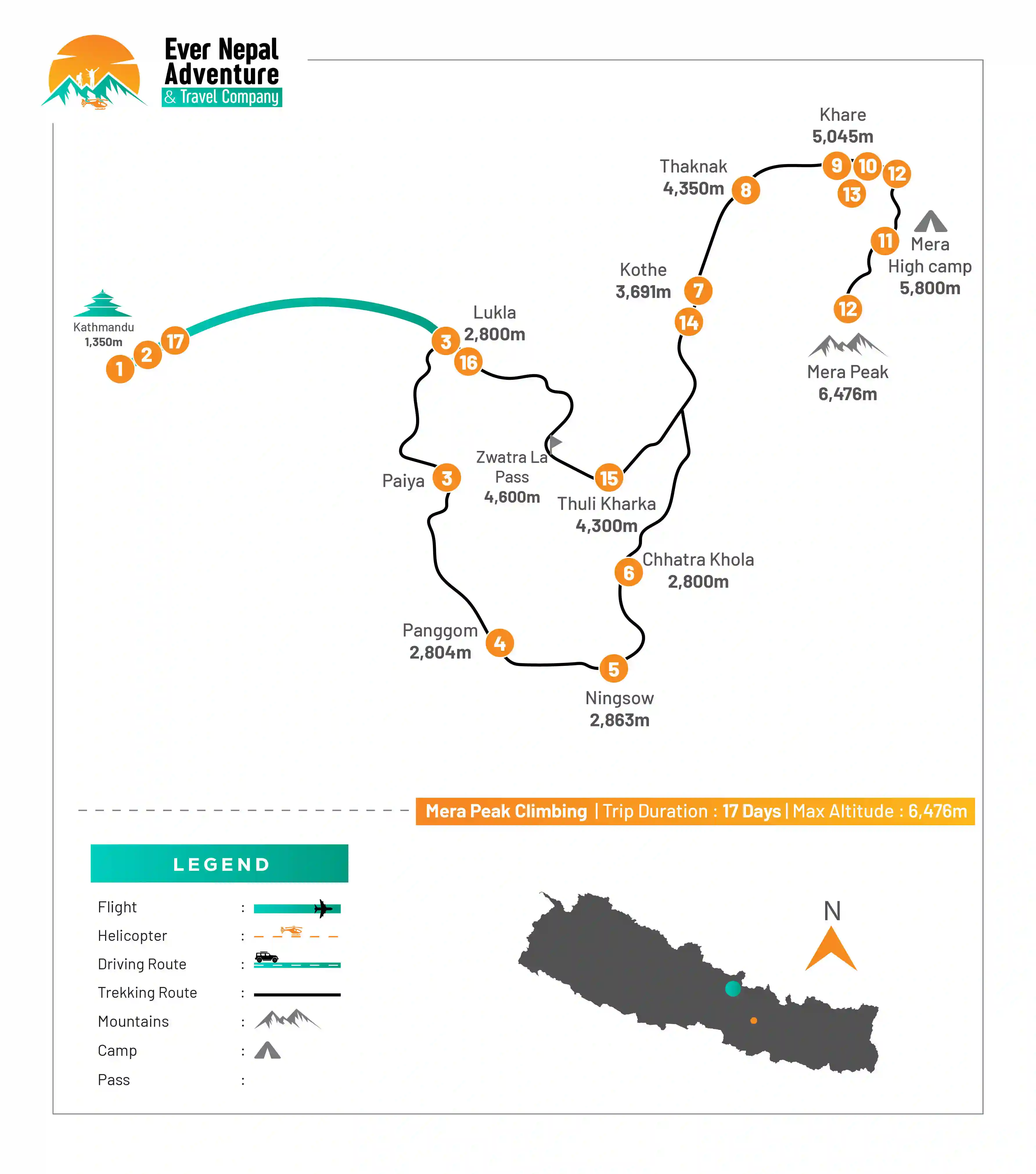
Trek Route

Mera Peak Climbing Route

What's included

  • Airport pick-up and drop-off in a comfortable private vehicle

  • Three nights stay in a 3-star hotel in Kathmandu (twin/double sharing with breakfast)

  • Accommodation in guesthouses or lodges during the trek as per the itinerary (twin/double sharing with breakfast, lunch, and dinner)

  • Farewell dinner with a cultural program

  • All ground transportation in a private, comfortable vehicle as mentioned in the itinerary

  • Domestic flights between Kathmandu and Lukla (both ways)

  • Experienced, English-speaking, government-licensed trek leader and assistant leader if needed

  • Porter service (1 porter for every 2 trekkers)

  • Safe drinking water during the trek

  • Tea, coffee, and light snacks during trekking days

  • All staff expenses including salary, insurance, equipment, food, accommodation, and domestic flights

  • Duffel bag, sleeping bag, T-shirt, and trekking map

  • All required trekking permits and paperwork (TIMS and National Park permits)

  • First aid kit carried by the trek leader

  • All government taxes and official charges

  • Guaranteed departures

  • Lifetime deposit

  • No booking fees

What's excluded

  • International flight tickets

  • Nepal entry visa (available on arrival at Tribhuvan International Airport in Kathmandu)

  • Travel insurance, including emergency evacuation costs

  • Lunch and dinner in Kathmandu

  • Personal expenses such as shopping, drinks, and laundry

  • Extra hotel nights in Kathmandu due to early return from the trek

  • City sightseeing tours and entrance fees

  • Tips for guides, porters, and drivers (tipping is expected)

  • Any cost not mentioned in the itinerary

User Review